
BOONE, N.C. — Sitting across a campus table with a notebook full of ideas for an upcoming eco-socialism talk, Katie Kitchen moves between thoughts the way they move between organizations, quickly and with obvious intention. As president of Triota and the Philosophy Club and a core organizer with Tempest, a socialist organizing group, their weeks are dense with meetings, events and the kind of connective work that rarely shows up on a resume.
“Everything I do is oriented toward building community,” said Kitchen, a senior double majoring in philosophy and gender, women's and sexuality studies (GWS) at Appalachian State University. “I think that's the only way we get out of this hellscape.”
That orientation goes back further than college. Kitchen grew up in Eighty Four, Pennsylvania, a rural township of about 600 people south of Pittsburgh, where they kept chickens as pets and spent afternoons sitting in the coop reading. When one of those chickens died and the family ate chicken nuggets for dinner that same night, something shifted in the 7-year-old that never quite shifted back.
“At the ripe age of 7, I was like, what's going on here?” Kitchen recalled. They stopped eating meat not long after, becoming the only vegetarian in their family, and eventually went vegan. The concern for animals, they say, was always there. It just took years to find its academic home.
That home was nearly never found. By their sophomore year at App State, Kitchen was on academic probation and close to dropping out entirely. An animal ethics course changed that.
“I was about to drop out, actually. I was on academic probation, took animal ethics, and was like, wait, school can be good,” Kitchen said. “School can be really cool.”
The course nudged them toward philosophy, and they added it as a second major alongside GWS, spending an extra year at App State to make both work. Around that same time, Emily Lutenski joined the GWS faculty, arriving almost exactly when Kitchen needed a mentor. Lutenski encouraged them to look into research opportunities, and with one day left before the deadline, Kitchen found and applied for the Tom Regan Animal Rights Research Fellowship.
“Two of those three said I probably would not get it,” Kitchen noted of the letter writers they recruited for the application, who were warning them about the fellowship's competitiveness rather than discouraging them. “And I got it.”
That research now forms the foundation of the philosophy capstone Kitchen is finishing, a paper examining the intersections between the feminist movement and the animal rights movement and arguing that the same forces fracturing one are at work in the other. The deeper point, they say, runs through every liberation struggle.
“There's just a push to hyper-individualize these movements, which is good to an extent,” Kitchen said. “But then you get divisions between groups and infighting and all sorts of things.”
Tempest operates as a direct answer to that problem. The group works with organizations across the area even when full ideological agreement is not possible, serving as a clearinghouse for resources and connections. Kitchen recently led a Tempest talk on eco-socialism and helped organize a talk on the defunding of ICE.
“We work with every single group in the area, even if we don't fully agree with them on some things,” they explained. “If we know one group needs some sort of resource, we can connect them.”
Outside of campus organizing, Kitchen writes and edits for the D-Word Times, a local zine, and last fall spent five days volunteering at a farm sanctuary in Providence, North Carolina, through an alternative service experience. It was there that they helped a sheep learn to use a custom-built wheelchair and spent most of a week with a pig who would roll onto her back for belly rubs.
“People are so quick to be like, just euthanize them,” Kitchen said of animals with disabilities. “We shouldn't do that to people. And I don't think we should do that to animals either.” The philosophy extends beyond animals to how Kitchen views community broadly. As disability scholar Sunaura Taylor writes, “All of us exist along a spectrum of dependency...rather than as an integral part of our world and our relationships.”
Growing up in rural Pennsylvania made the cost of not fitting in clear from an early age. Kitchen was the first openly queer person in their seventh-grade class in a large school district drawn from miles of farmland, and the years that followed were hard. The same visibility that made them a target also made them someone others came to.
“I was relentlessly bullied, but I was also someone that people knew they could talk to about those things,” they said. “So it had its benefits, ultimately.”
Leaving Pennsylvania for Boone changed things. A student who had struggled with severe social anxiety and undertreated ADHD found their footing somewhere new, helped along by medication that finally worked and communities that finally fit. The change was not small.
“Some switch flipped, and I was like, actually, I'm going to insert myself into every space I can,” Kitchen added. “It's working out.”
That shift carries into how they approach disagreement. Kitchen has been pushing themself to stay in harder conversations rather than walking away from them.
“If I have the capacity to help them learn something or develop a sense of empathy, and they're willing to meet me kind of where I'm at, who am I to deny them that opportunity?” they said regarding those with other views.
The philosophy underneath all of it is simple. If someone has a deficit and you have a surplus, you help them. You pay for the groceries of the person whose card is declining. You build the community that makes those moments possible.
Looking ahead, Kitchen is applying to fully funded Ph.D. programs in philosophy but hasn't ruled out law school, particularly in immigration or animal rights law.
“I want to be an advocate for animal rights through law,” they said.
More than any degree or title, though, the goal is the same one that started with a pet chicken in Pennsylvania and a plate of chicken nuggets.
“More than anything, I just want to help as many people as I possibly can, or as many non-human animals as I can,” Kitchen said. “If I can somehow make that a career, or at least a livable thing, then I will.”
It comes down, they say, to something most people could do but rarely take the time for. Knowing your neighbor, not just loving them, is where community actually starts.
###
About the Department of Interdisciplinary Studies
The Department of Interdisciplinary Studies offers graduate and undergraduate degrees in four program areas: Appalachian studies; gender, women’s and sexuality studies; global studies; and interdisciplinary studies. The department is also home to Watauga Residential College, an interdisciplinary, alternative general education program. The department promotes creative and imaginative engagement through a cross-disciplinary investigation of complex systems and problems. Learn more about the Department of Interdisciplinary Studies
About the College of Arts and Sciences
The College of Arts and Sciences (CAS) at Appalachian State University is home to 17 academic departments, two centers and one residential college. These units span the humanities and the social, mathematical and natural sciences. CAS aims to develop a distinctive identity built upon our university's strengths, traditions and locations. The college’s values lie not only in service to the university and local community, but through inspiring, training, educating and sustaining the development of its students as global citizens. More than 6,800 student majors are enrolled in the college. As the college is also largely responsible for implementing App State’s general education curriculum, it is heavily involved in the education of all students at the university, including those pursuing majors in other colleges. Learn more about CAS
About Appalachian State University
As a premier public institution, Appalachian State University prepares students to lead purposeful lives. App State is one of 17 campuses in the University of North Carolina System, with a national reputation for innovative teaching and opening access to a high-quality, cost-effective education. The university enrolls more than 21,000 students, has a low student-to-faculty ratio and offers more than 150 undergraduate and 80 graduate majors at its Boone and Hickory campuses and through App State Online. Learn more about App State
By Evan Atkins (evancreation@proton.me)
February 23, 2026
BOONE, N.C.
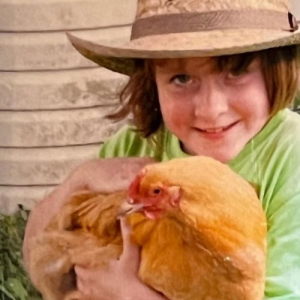
A child in a hat and green shirt smiling and holding a chicken.
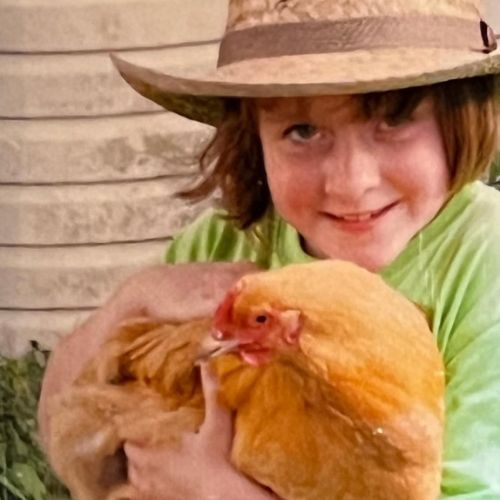
Katie Kitchen